

Search Engines Are Starving For Industrial Manufacturing Stories
It’s been two years since Google rolled out AI Overview, a tool that accelerates what marketers call zero-click search: search results that answer a user’s question without requiring them to click through to a website. While the AI Overview is convenient for finding quick answers to questions like, “What tolerances can you hold on formed stainless steel?”, the AI Overview can be detrimental to industrial manufacturers that rely exclusively on commodity content for their marketing and sales plan.
AI has made generic industrial content easier to produce and less valuable to publish. The manufacturers that win search from here won’t be the ones writing another basic “What is CNC machining?” article. They’ll be the ones turning real projects, real equipment, real lessons, and real shop-floor expertise into content that competitors can’t copy.
What is Commodity Content?
Commodity content is content that could appear on almost any competitor’s website with only minor changes. It usually answers basic search questions, explains common industry terms, or summarizes information that already exists in dozens of other places online.
For industrial manufacturers, commodity content might include posts like “What Is Metal Fabrication?”, “Benefits of Laser Cutting,” or “How CNC Machining Works.” These topics can still be useful, but on their own, they rarely prove why your company is the right choice.
The problem isn’t that these topics are bad. The problem is that they’re incomplete. A basic explainer becomes much more valuable when it includes your actual equipment, tolerances, project examples, customer questions, team insights, or lessons learned from the shop floor.
Google is Deprioritizing Commodity Content in 2026
As more AI-generated content populates the internet, Google has started to deprioritize this type of commodity content because it can be virtually duplicated by your competitors in a matter of seconds. But this leaves Google starving for sources that are actually credible. The easiest way for industrial manufacturers to signal to Google that they’re a real and reliable source of information is to weave real-world stories and experiences from their shop into their website and blog posts.
Design Content That Your Competitors Can’t Steal
That’s why our clients’ blogs focus on content that could only belong to them. Non-commodity pieces include case studies, interviews with experts on your team, and sharing your team’s top learning moments. Integrating this information into your blog will help your webpage stand out, as Google will reward you for providing a fresh take to the search engine, rather than adding one more surface-level blog to the void.
Here's an example where HeyPropellant has done exactly that for two manufacturing clients. Rather than writing about what their industries already cover, we've built content around what only they can speak to: the internal systems and philosophies behind how they operate, the stances they're willing to take that most competitors won't, and the real-world cost and ROI data that comes from selling and using this equipment every day.
We pull that knowledge out through direct conversations with the people on the floor and the experts behind the sales process, then shape it into content that reflects a genuine point of view. None of it can be lifted and republished under a competitor's name.
And the results back it up: over the past 90 days, 3 of the top 10 performing pages for both clients have been non-commodity blogs, proof that Google rewards a fresh take.
How to Turn a Commodity Post into Powerfully Unique Content
Below are a few examples of how industrial manufacturers can turn commodity content into non-commodity content.
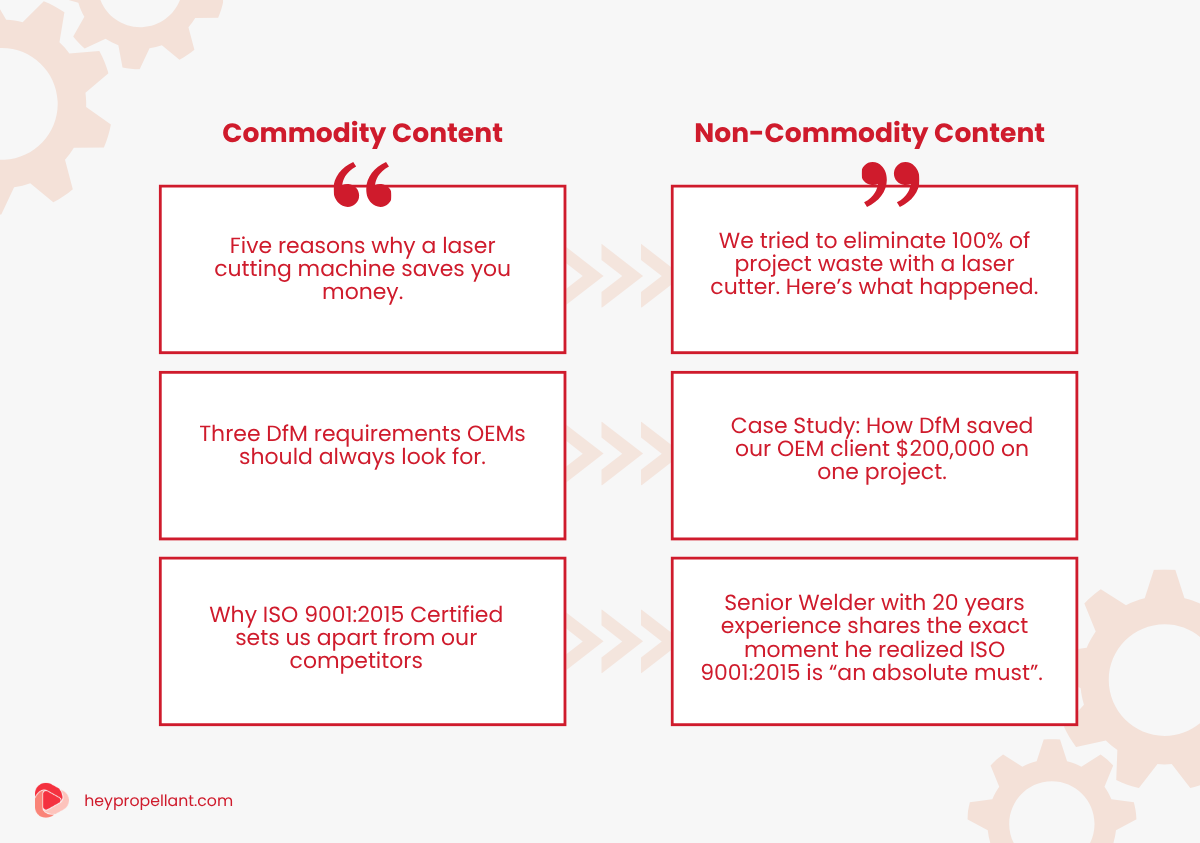
Commodity content compared to non-commodity content for industrial manufacturing websites.
But, Don’t Throw Out Your Commodity Content Completely…
Though Google is beginning to prioritize more non-commodity content, don’t throw out all of your commodity content completely. When commodity content is correctly optimized for AI, your business’s page has the potential to show up as a source in the AI overview that can generate leads to your website. The key is to integrate more of the commodity content onto your site's static webpages, rather than dumping it entirely into blog posts. For example, incorporating detailed “Frequently Asked Questions” sections to our clients’ webpages boosted site visits across the board.
The Takeaway
AI-generated or not, generic content is flooding the internet right now. Thoughtfully crafted blog posts that exemplify your industrial manufacturing expertise prove to Google that your page is worth showing on the first page of search results, and build trust with future customers.
Your team already has the expertise. The trick is getting it out of people’s heads and onto the site in a way buyers and search engines can understand.